Problem solvers
Once we have our data prepared for analysis and processing, we can employ a set of Solvers for the task. The MODA library implements variety of hypervolume centered methods. This section lists all the solvers and provides simple code snippets for each of the algorithms.
Solvers
Let’s start by listing all the base types. The library uses a hierarchical structure, each task is executed with a dedficated solver. The solver accepts a set of hyperparameters and returns a result embedded in an object of a dedicated type. Before we move onto the detailed solvers, let’s describe the base classes.
Base Solver Class
-
class Solver
The base class providing an interface and utility methods for solving optimization problems.
-
DataSetParameters *currentSettings
Pointer to the configuration settings for the current problem.
-
void (*StartCallback)(DataSetParameters problemSettings, std::string SolverMessage)
Called when the solver starts execution.
-
void (*IterationCallback)(int currentIteration, int totalIterations, Result *stepResult)
Called at the end of each iteration to report progress.
-
void (*EndCallback)(DataSetParameters problemSettings, Result *stepResult)
Called upon the completion of the solving process.
Public Methods
-
virtual Result *Solve(DataSet *problem, SolverParameters settings)
Abstract Solve function. Each solver implements it to solve the problem and return a result.
Protected Methods
-
void prepareData(DataSet *problem, SolverParameters settings)
Prepares operational data structures before starting the solver.
-
DataSetParameters *currentSettings
The moda library utilizes a configuration system for various optimization solvers. All specific solver settings inherit from the base SolverParameters class.
Base Solver Parameters Class
-
class SolverParameters
The foundational class for all solver configurations.
-
enum ReferencePointCalculationStyle
Enumeration of all methods for calculating the reference points. Depending on the optimization direction, the worse and better reference points are set either to the point based on either minimum or maximum values, approprietly
-
enumerator epsilon
For the dataset \(X \subseteq \mathbb{R}^n\), define the minimum and maximum values for each dimension \(i\) as:
\[m_i = \min_{x \in X} (x_i), \quad M_i = \max_{x \in X} (x_i) .\]The adjusted reference points are defined as:
\[ \begin{align}\begin{aligned}\{ m_i - \epsilon \mid 0 < i \le n \},\\\{ M_i + \epsilon \mid 0 < i \le n \} .\end{aligned}\end{align} \]The parameter \(\epsilon\) is currently set to a default value of 0.001. You can modify this value by updating the corresponding constant in the
include.hfile.
-
enumerator tenpercent
For the dataset \(X \subseteq \mathbb{R}^n\), define the minimum and maximum values for each dimension \(i\) as:
\[m_i = \min_{x \in X} (x_i), \quad M_i = \max_{x \in X} (x_i) .\]The adjusted reference points are defined as:
\[ \begin{align}\begin{aligned}\{ m_i - 0.1 \cdot |m_i - M_i| \mid 0 < i \le n \},\\\{ M_i + 0.1 \cdot |m_i - M_i| \mid 0 < i \le n \} .\end{aligned}\end{align} \]
-
enumerator zeroone
For the dataset \(X \subseteq \mathbb{R}^n\), the reference points are defined as:
\[ \begin{align}\begin{aligned}\{ 0 \mid 0 < i \le n \},\\\{ 1 \mid 0 < i \le n \} .\end{aligned}\end{align} \]
-
enumerator userdefined
The reference points are defined by user prior to the solver execution. In order to use this setting declare the worseReferencePoint and betterReferencePoint values.
-
enumerator exact
For the dataset \(X \subseteq \mathbb{R}^n\), the reference points are defined as:
\[ \begin{align}\begin{aligned}\{ \min_{x \in X} (x_i) \mid 0 < i \le n \},\\\{ \max_{x \in X} (x_i) \mid 0 < i \le n \} .\end{aligned}\end{align} \]
-
enumerator pymoo
For the dataset \(X \subseteq \mathbb{R}^n\), define the minimum and maximum values for each dimension \(i\) as:
\[m_i = \min_{x \in X} (x_i), \quad M_i = \max_{x \in X} (x_i) .\]The adjusted reference points are defined as:
\[ \begin{align}\begin{aligned}\{ 0 \mid 0 < i \le n \},\\\{ 11 \mid 0 < i \le n \} .\end{aligned}\end{align} \]
-
enumerator epsilon
-
ReferencePointCalculationStyle BetterReferencePointCalculationStyle
How to calculate the better reference point (see the enum above).
-
ReferencePointCalculationStyle WorseReferencePointCalculationStyle
How to calculate the worse reference point (see the enum above).
-
bool callbacks
Toggle to enable or disable iteration callbacks.
-
int MaxEstimationTime
Maximum time allowed for the estimation process (in ms).
-
Point *worseReferencePoint;
User defined reference point;for minimization: lower boundary point of the problem; for maximization: upper boundary point of the problem
-
Point *betterReferencePoint;
User defined reference point; for minimization: upper boundary point of the problem; for maximization: lower boundary point of the problem
-
enum ReferencePointCalculationStyle
Base Result Class
The base result class is very simple it only denotes the elapsed time and information wether this is the final or intermediate result. Additionally it carries meta information on the method name and auxiliary, additional denotion of the result type.
-
class Result
Represents the output and metadata for a calculation process.
-
int ElapsedTime
Time passed since the beginning of the calculation given in ms.
-
bool FinalResult
Is this the final result of the calculation.
-
enum ResultType
Enumeration of all result types.
-
enumerator Hypervolume
-
enumerator Estimation
-
enumerator Contribution
-
enumerator SubsetSelection
-
enumerator R2
-
enumerator Hypervolume
-
ResultType type
Additional annotation of the result type (auxiliary).
-
std::string methodName
The name of the method used for the calculation.
-
int ElapsedTime
Dedicated Solvers
MODA library uses a hierarchical structure of solvers designated for various tasks. This set of derived classes servers as a programming interface to the library computation kernel.
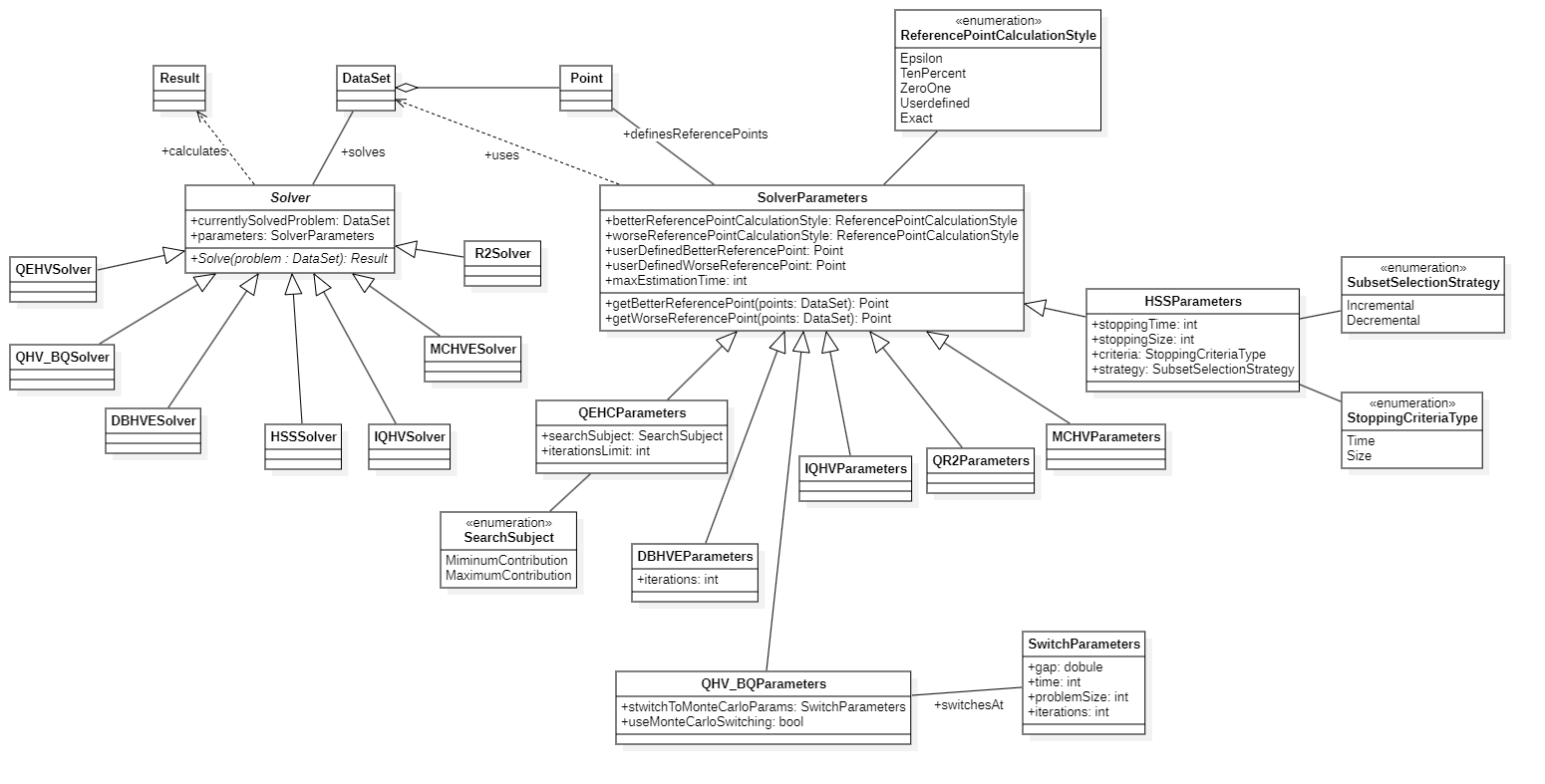
Solvers Hierarchy.
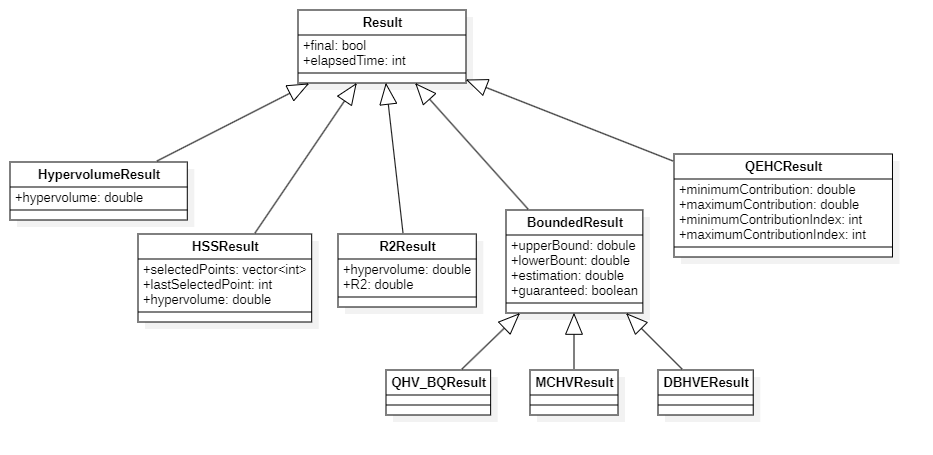
Results Hierarchy.
Improved Quick Hypervolume
Classes
-
class IQHVSolver : public Solver
This class implements exact hypervolume calculation as described in [Andrzej Jaszkiewicz. 2018. Improved quick hypervolume algorithm. Comput. Oper. Res. 90, C (February 2018), 72–83. https://doi.org/10.1016/j.cor.2017.09.016]
-
class IQHVParameters : public SolverParameters
Settings for IQHV - a method of finding exact hypervolume. This class includes no additional parameters.
Code snippet
#include <moda\DataSet.h>
#include <moda\IQHVSolver.h>
#include <moda\SolverParameters.h>
#include <moda\Point.h>
#include <iostream>
int main()
{
   moda::DataSet* dataSet = moda::DataSet::LoadFromFilename("sample_file");
   dataSet->normalize();
   moda::IQHVSolver solver;
   moda::IQHVParameters* parameters = new moda::IQHVParameters(moda::SolverParameters::ReferencePointCalculationStyle::zeroone, moda::SolverParameters::ReferencePointCalculationStyle::zeroone);
   moda::HypervolumeResult* result = solver.Solve(dataSet, *parameters);
   std::cout << "Hypervolume: " << result->HyperVolume << std::endl;
   return 0;
}
//Result:
//   Hypervolume: 0.859209
Distance based hypevolume estimation
Classes
This class implements the hypervolume estimation as described in [Jaszkiewicz, Andrzej & Zielniewicz, Piotr. (2024). Improving the Efficiency of the Distance-Based Hypervolume Estimation Using ND-Tree. IEEE Transactions on Evolutionary Computation. PP. 1-1. 10.1109/TEVC.2024.3391857.]
-
class DBHVEParameters : public SolverParameters
Settings for DBHVE - a method of finding hypervolume estimation expressed as a real number.
-
unsigned MCIterations
Number of iterations.
-
unsigned MCIterations
-
class BoundedResult : public Result
Result class providing bounded estimation values, inheriting from
Result. This class will be used for all “bounded” result types.-
bool Guaranteed
Flag indicating if the lower and upper bounds are exact. If true, the precise value is guaranteed to be within these bounds. This is typically false for Monte Carlo methods.
-
float LowerBound
Lower bound of the hypervolume.
-
float UpperBound
Upper bound of the hypervolume.
-
float HyperVolumeEstimation
The estimated hypervolume value.
-
bool Guaranteed
Code Snippet
Quick Extreme Hypervolume Contributon
Classes
This class implements an algorithm for finding the extreme hypervolume contributor. It is described in [Andrzej Jaszkiewicz and Piotr Zielniewicz. 2021. Quick extreme hypervolume contribution algorithm. In Proceedings of the Genetic and Evolutionary Computation Conference (GECCO ‘21). Association for Computing Machinery, New York, NY, USA, 412–420. https://doi.org/10.1145/3449639.3459394]
-
class QEHCParameters : public SolverParameters
Parameters for the QEHC Solver.
-
enum SearchSubjectOption
-
enumerator MinimumContribution
The QEHC process will search for minimum contributor.
-
enumerator MaximumContribution
The QEHC process will search for maximum contributor.
-
enumerator Both
The QEHC process will search for both maximum and minimum contributor at once (not implemented).
-
enumerator MinimumContribution
-
enum SearchSubjectOption
-
class QEHCResult : public Result
Result class specific to Quick Hypervolume Contribution (QEHC) metrics, inheriting from
Result.-
float MaximumContribution
The lowest contribution value for any single point in the set.
-
float MinimumContribution
The highest hypervolume (HV) contribution value for any single point in the set.
-
int MaximumContributionIndex
The index of the point associated with the highest HV contribution value.
-
int MinimumContributionIndex
The index of the point associated with the lowest HV contribution value.
-
float MaximumContribution
Code snippet
#include <moda\DataSet.h>
#include <moda\QEHCSolver.h>
#include <moda\SolverParameters.h>
#include <moda\Point.h>
#include <moda\Result.h>
#include <iostream>
int main()
{
   moda::DataSet* dataSet = moda::DataSet::LoadFromFilename("sample_file");
   dataSet->normalize();
   moda::QEHCSolver solver;
   moda::QEHCParameters* parameters = new moda::QEHCParameters(moda::SolverParameters::ReferencePointCalculationStyle::zeroone, moda::SolverParameters::ReferencePointCalculationStyle::zeroone);
   parameters->SearchSubject = moda::QEHCParameters::SearchSubjectOption::MaximumContribution;
   moda::QEHCResult* result = solver.Solve(dataSet, *parameters);
   std::cout << "Maximum contribution: " << result->MaximumContribution << std::endl;
   std::cout << "Maximum contributor index: " << result->MaximumContributionIndex << std::endl;
   return 0;
}
//Result:
//   Maximum contribution: 0.00114615
//   Maximum contributor index: 21
Hypervolume Subset Selection
Classes
This class implements a method of finding a subset of points with best estimated hypervolume, according to the algorithm described in [Andrzej Jaszkiewicz, Piotr Zielniewicz: Lazy Hypervolume Subset Selection Algorithm with Contributions Update. GECCO Companion 2025: 223-226]
-
class HSSParameters : public SolverParameters
Configuration for HSS solvers.
-
enum StoppingCriteriaType
Enumeration of various HSS termination criteria.
-
enumerator SubsetSize
The process will terminate once a specified size of the set of selected points has been reached.
-
enumerator Time
The process will terminate once a specific time of execution has been reached (note, the time is checked upon the start of iteration, which selects a point, at least one point will be added/substracted).
-
enumerator SubsetSize
-
enum SubsetSelectionStrategy
Enumeration of HSS processing strategies.
-
enumerator Incremental
Start with an empty set. In every iteration add a point, which would maximize the hypervolume of the subset.
-
enumerator Decremental
Start with all points. In every iteration remove a point, which would reduce the hypervolume by the minimal value.
-
enumerator Incremental
-
StoppingCriteriaType StoppingCriteria
HSS termination criteria.
-
SubsetSelectionStrategy Strategy
HSS processing strategy.
-
enum StoppingCriteriaType
Code Snippet
#include <moda\DataSet.h>
#include <moda\HSSSolver.h>
#include <moda\SolverParameters.h>
#include <moda\Point.h>
#include <moda\Result.h>
#include <iostream>
int main()
{
   moda::DataSet* dataSet = moda::DataSet::LoadFromFilename("sample_file");
   dataSet->normalize();
   moda::HSSSolver solver;
   moda::HSSParameters* hssparams = new moda::HSSParameters(moda::SolverParameters::ReferencePointCalculationStyle::zeroone, moda::SolverParameters::ReferencePointCalculationStyle::zeroone);
   hssparams->Strategy = moda::HSSParameters::SubsetSelectionStrategy::Incremental;
   hssparams->StoppingSubsetSize = 10;
   hssparams->StoppingCriteria = moda::HSSParameters::StoppingCriteriaType::SubsetSize;
   auto result = solver.Solve(dataSet, *hssparams);
   std::cout << "Selected points: [";
   for (int i = 0; i < 10; i++)
   {
      std::cout << result->selectedPoints[i] << ",";
   }
   std::cout << "]";
   return 0;
}
//Result:
//   Selected points: [48,349,246,217,296,358,376,53,478,7,]
Quick Hypervolume Guaranteed Bounds Approximation
Classes
-
class QHV_BRParameters : public SolverParameters
Settings for QHV-BR - a method of finding hypervolume estimation expressed as lower and upper bounds. This method requires no additional parameters.
This class uses the BoundedResult class.
Code Snippet
Quick Hypervolume Bounds Estimation with Priority Queue
Classes
-
class QHV_BQParameters : public SolverParameters
Settings for QHV-BQ - a method of finding hypervolume estimation expressed as lower and upper bounds.
-
SwitchParameters SwitchToMCSettings
Configuration for switching to Monte Carlo methods.
-
bool MonteCarlo
Toggle to turn on/off Monte Carlo estimation. If turned on, the algorithm will switch to Monte Carlo estimation once specific termination criteria are satisfied (look at SwitchToMCSettings).
-
SwitchParameters SwitchToMCSettings
-
class SwitchParameters
Internal configuration for algorithm switching logic.
-
int switchTime
Threshold in ms to switch to Monte Carlo.
-
DType gap
Once the difference between lower and upper bounds of the estimation is lower than this value, switch to Monte Carlo.
-
int switchTime
This class uses the BoundedResult class.
Code Snippet
#include <moda\DataSet.h>
#include <moda\QHV_BQSolver.h>
#include <moda\SolverParameters.h>
#include <moda\Point.h>
#include <moda\Result.h>
#include <iostream>
int main()
{
   moda::DataSet* dataSet = moda::DataSet::LoadFromFilename("sample_file");
   dataSet->normalize();
   moda::QHV_BQSolver solver;
   moda::QHV_BQParameters* parameters = new moda::QHV_BQParameters(moda::SolverParameters::ReferencePointCalculationStyle::zeroone, moda::SolverParameters::ReferencePointCalculationStyle::zeroone);
   parameters->MaxEstimationTime = 320;
   auto result = solver.Solve(dataSet, *parameters);
   std::cout << "Lower bound: " << result->LowerBound << std::endl;
   std::cout << "Upper bound: " << result->UpperBound << std::endl;
   return 0;
}
//Result:
//    Lower bound: 0.825077
//    Upper bound: 0.897067